

Changing schools in Basel is a significant decision for any family.
Perhaps you have moved to Basel, your child’s needs have changed, you are thinking about the next stage of their education, or you have simply reached the point where you are wondering whether another school might be a better fit. Whatever the reason, changing schools can bring both excitement and uncertainty.
Finding the right environment is about more than comparing school websites or looking at league tables. It means considering your child’s education, wellbeing, friendships and future — as well as what works for your family.
If you are exploring your options, here are seven things worth considering.
1. Why are you considering a change?
Before looking at individual schools, it can be useful to identify exactly what you are looking for.
Is it a different curriculum? More language opportunities? Smaller classes? Greater academic support? A different approach to your child’s social and emotional wellbeing? Or perhaps you are simply looking for a school that better reflects your family’s international or bilingual background? Making a list of the things that matter most to your family can make it much easier to compare schools objectively. It is also worth asking your child what they think. Their priorities may be quite different from yours.
2. Which curriculum fits your family’s future plans?
Basel families have a range of educational pathways available to them, so it is worth thinking beyond the next school year.
Ask how a school’s curriculum develops as children get older and what qualifications it ultimately leads towards. If your family is international, you may also want to consider how easily your child could move between educational systems if you relocate in the future.
For example, ELABasel’s Primary School follows the Cambridge curriculum within a bilingual English-German programme. At Secondary level, families can choose between the Swiss Lehrplan 21 pathway and the Cambridge pathway, providing different routes depending on a student’s future educational plans. When visiting schools, ask not only, “What curriculum do you follow?” but also, “Where can this pathway take my child?”
If you’re new to Basel or unfamiliar with the local education system, the Canton of Basel-Stadt provides an overview of how the city’s state school system is structured (external link). 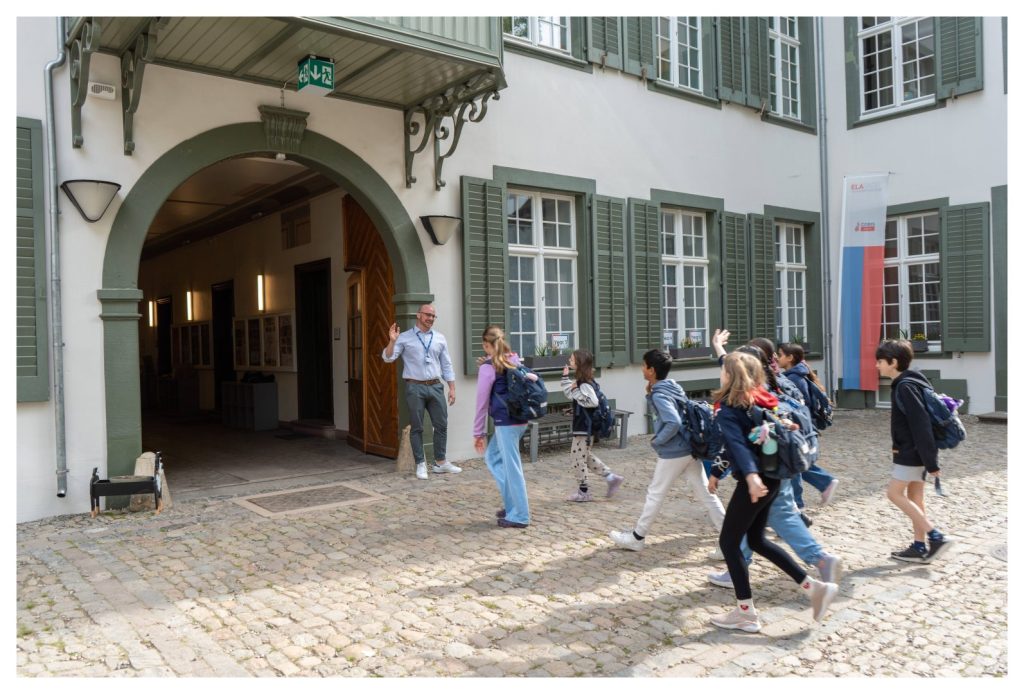
3. How are languages used in everyday school life?
For families living in Basel, language provision can be particularly important. A school may offer German or French lessons, but there is a significant difference between learning a language as a subject and having regular opportunities to use it in meaningful situations.
Consider asking:
- How much German or French will my child hear each week?
- Is the language used outside dedicated language lessons?
- Can children learn at different levels?
- What opportunities are there to practise languages socially?
- Is there support for both native speakers and children learning a new language?
At our school for example, German is integrated across the curriculum rather than being confined to language lessons. Pupils can progressively increase their exposure to German through subjects such as RZG (Räume, Zeiten, Gesellschaften/Spaces, Times, Societies), Maths and Science, as well as activities including PE and swimming.
The school also offers French and German programmes from Beginners to Advanced level, with French beginning from Year 2 and provision for native French speakers.
Taking languages beyond the classroom
Language learning can also extend beyond the classroom through enrichment activities, heritage classes, outings and events. Experiences such as our theatre visits, the Language Flea Market and trips to places such as Berne give pupils opportunities to use languages in real-world contexts.
The broader question to ask is: Will my child simply learn the language, or will they have opportunities to live it?
4. How will my child settle into a new school?
Starting at a new school is a big step for any child. New classrooms, new routines, new teachers and new friendships can take time to get used to.
When choosing a school, ask how much attention is given to the settling-in process, particularly during those first few weeks. The priority should not necessarily be academic progress straight away, but helping a child feel safe, comfortable and familiar with their new surroundings.
Find out:
- Who will greet my child when they arrive?
- How will they learn the school’s routines?
- How will the school help them make new friends?
- How will teachers adapt learning while they are settling in?
- How will I know how my child is doing?
For your reference when visiting schools, our Inclusion Team plays an active role in helping new children and families settle in. During the initial period, members of the team meet new children and families at the school gate each morning, helping children become familiar with their new routines and providing a familiar, reassuring face as they arrive. New families are also invited to Meet and Greet events, providing an opportunity to get to know other families and begin building connections within the school community.
Inside the classroom, teachers can differentiate learning to support individual children as they become familiar with their new environment. However, the initial focus is on settling in, building confidence and developing a sense of belonging, rather than putting immediate academic pressure on a child. Parents are also kept closely informed, with feedback provided regularly — including daily communication during the initial settling-in period where appropriate. This kind of support can make a significant difference. A child who feels comfortable, understood and connected is much better placed to engage with their learning and begin building relationships in their new school.
5. What does the school offer beyond the classroom?
A child’s school experience is about more than academic lessons. Consider what opportunities are available in areas such as sport, music, performing arts, STEM, creative subjects, clubs, trips and enrichment.
These experiences can help children discover interests, develop confidence and build relationships with other pupils.
STEM is one example. At ELABasel, pupils take part in activities including STEM Week, Family STEM Night and a Science Fair, alongside opportunities to learn from workshops led by visiting professionals from the wider community. Visiting specialists can bring subjects to life in ways that a textbook cannot — from local industry professionals to specialists who share their expertise with older pupils.
Performing arts can provide another valuable dimension to school life. Our students have the opportunity to perform in our Scala Theatre shows, giving them the chance to develop their confidence, creativity and communication skills while working collaboratively towards a professional theatre production. For many children, stepping onto a stage in front of an audience can be a memorable experience that helps them develop skills and self-belief that extend well beyond the performance itself. See for yourself here.
When comparing schools, ask yourself, “What opportunities will my child have to discover what they are good at, develop new interests and build confidence beyond the classroom?”
6. How does the school communicate with parents?
Changing schools is a significant change for the whole family, not just the child. Good communication can make the transition considerably easier. Parents should feel informed about what is happening in school and confident about who to contact if they have a question or concern. When comparing schools, look beyond formal parent meetings and newsletters. Ask how the school gives families an inside look at everyday teaching and learning.
Weekly classroom updates, photographs and examples of pupils’ work can help parents see what their children are learning and experiencing, even when they are not physically in the classroom. For example, our Weekly Bulletins give parents regular updates from classrooms across the school, often accompanied by photographs and examples of learning. It is also worth finding out whether there are opportunities to meet other parents and become involved in the wider school community. Our new families are introduced to ‘FELA’ (Friends of ELABasel), the school’s parent association, which helps them build connections and become part of the school community.
Ultimately, good communication should work both ways — keeping parents informed while also giving them opportunities to ask questions, share feedback and feel connected to their child’s education.
For families new to Basel, the Canton of Basel-Stadt also provides useful information about how parents and schools work together (external link), including communication and parental involvement.
7. Visit the school before making your decision
Websites, prospectuses and social media can tell you a great deal about a school. But there is no substitute for seeing it for yourself.
When you visit, try to look beyond the buildings and facilities. Observe the atmosphere, talk to teachers and, if possible, bring your child so they can experience the environment for themselves.
Ask yourself:
- Do the pupils seem happy and engaged?
- Do teachers know their pupils well?
- Does the atmosphere feel welcoming?
- Can I see how languages are used in practice?
- What support would be available if my child needed it?
- Can I understand the educational pathway beyond Primary School?
- Does the school communicate openly with parents?
- Could my child see themselves belonging here?
And, perhaps most importantly, ask your child what they think.
Come and see for yourself
One of the best opportunities to get a genuine feel for a school is to attend an Open Day. It gives families the chance to explore the facilities, meet teachers, ask questions and see how the school environment feels in person.
ELABasel’s next Open Day takes place on Saturday, 24th October 2026, from 10:00–14:00, with families able to visit across our different stages of education.
The Primary and Secondary School Open Day takes place at our Wildensteinerhof campus at St. Alban-Vorstadt 32, where families can discover our established Primary School as well as our new Secondary School.
Our Early Years/Kita Open Day takes place at Gartenstrasse 93, giving families with younger children an opportunity to explore our Early Years provision.
Whether you are actively considering a change of school or simply beginning to explore your options, an Open Day can be a useful first step. You can ask the questions that matter to your family, meet the people who could be teaching your child and get a sense of whether the school feels like the right environment.
Sometimes, the best way to decide is simply to come and see for yourself.
Want to explore further?
If you’re still researching your options, you can find out more about the different stages of education at ELABasel:
Frequently Asked Questions About Changing Schools in Basel
When is the right time to change schools?
There is no single right time. Some families change schools at the start of a new academic year, while others move when their child’s needs, family circumstances or educational plans change. If you are considering a move, think about both the practical timing and how your child is likely to experience the transition.
Will my child be able to settle into a new school?
Most schools will have a process to help new pupils settle in, but the level of support can vary. When visiting a potential new school, ask how they welcome new children, introduce them to classmates, communicate with parents and monitor their wellbeing during the first few weeks.
Does my child need to speak the school’s main language before joining?
Not necessarily. This depends on the school, year group and language programme. Some schools offer support for children who are developing proficiency in the language of instruction, while others have specific entry requirements. It is worth discussing your child’s current language skills with the school before applying.
What should I ask when visiting a school?
Try to look beyond the classrooms and facilities. Ask about the curriculum, languages, class sizes, learning support, communication with parents, how new pupils settle in and what happens when your child moves on to the next stage of education. Most importantly, consider how your child responds to the atmosphere of the school.
Is it worth visiting several schools before deciding?
Yes. A school can look very different online from how it feels when you walk through the door. Visiting gives you the opportunity to see how pupils and teachers interact, ask questions specific to your child’s needs and get a sense of whether the school feels like the right environment for your family.